
How to Sell on Myntra : The Complete Seller Guide (2026)
Are you thinking of selling on Myntra but don’t know where to start? Don’t stress out because you are not alone. You are among the thousands of sellers who ask the same questions. How to sell products on Myntra? What documents are needed? How to sell on Myntra without GST? The list goes on and on.
Myntra has become one of India’s biggest fashion and lifestyle marketplaces. It’s the favourite platform among fashion lovers. But the Myntra seller registration process can feel overwhelming. It’s not the same as Flipkart or Amazon. That’s where Myntra seller account management services come in handy.
But if you want the full picture yourself, this guide covers everything: why sellers choose Myntra, who’s eligible, the GST requirement, documents, selling models, the complete registration process, and how to actually grow once you’re live. So, stick to the end!
Key Takeaways
- Myntra seller registration requires a valid GSTIN, PAN, and a registered business entity. GST is a must to complete the registration process.
- Myntra prioritizes registered brands and manufacturers over unbranded resellers.
- New, homegrown D2C brands can apply for Myntra’s zero-commission program (Myntra Rising Stars) during their early growth phase.
- The Myntra account approval isn’t instant. It takes a few weeks.
- Once approved, everything from catalog to payments runs through the Myntra seller portal, and how well you perform there shapes your long-term visibility on the platform.
Why Sell on Myntra? Discover the Key Benefits for Sellers
Before you know the process, it’s good to know why you should sell on Myntra. So, below are some benefits of selling on Myntra:
1. Access to a large, fashion-focused audience
Myntra has over 75 million monthly active users and delivery coverage across roughly 98% of serviceable pin codes in India. By selling on Myntra, you can reach a wide audience.
2. Full control over your merchandise
Myntra sellers can set their own pricing, manage quality standards, and control quantity.
3. Faster delivery infrastructure
Myntra has been investing in quicker delivery timelines through its own logistics network, including a newer quick-delivery push branded M-Now, which sellers can tap into without building last-mile logistics themselves.
4. Built-in analytics
The Myntra seller portal gives you real-time sales, inventory, and performance data without needing separate analytics tools.
5. No payment gateway setup
Myntra handles customer payments end-to-end; you don’t need to integrate or manage a payment processor.
Myntra's Zero-Commission Model for New D2C Brands
If you’re a new, homegrown fashion, beauty, or lifestyle brand, it’s worth knowing about Myntra Rising Stars (MRS). It’s the platform’s zero-commission initiative, officially launched in January 2026.
Under this model, eligible brands can sell on Myntra without paying marketplace commission during their initial growth phase. It’s designed for:
- Indian D2C brands primarily selling through their own website or social channels
- Early-stage or scaling brands looking to reduce customer acquisition costs
- Brands wanting logistics and demand-generation support without heavy ad spend
As of early 2026, over 2,000 fashion, beauty, and lifestyle brands were already part of the MRS programme. It’s not for generic resellers or distributors. Myntra is prioritizing original, homegrown brands here. If this describes your business, it’s worth asking about MRS eligibility specifically when you apply, since it isn’t the default registration path.
Who Can Sell on Myntra?
Now, before you start the registration process, it’s worth checking whether you are even eligible for selling or not. Myntra isn’t an open marketplace like others are. It’s built around fashion, beauty, and lifestyle brands.
An individual can’t sell on Myntra. You need a legally registered business entity. It accepts:
- Sole proprietorships — the simplest structure, common for small fashion sellers and first-time entrepreneurs.
- Partnership firms — suited to small and mid-sized manufacturers or distributors.
- Private Limited Companies — the preferred structure for established brands and D2C companies, since it meets Myntra’s higher compliance bar.
- Limited Liability Partnerships (LLPs) — a good fit for growing brands planning to expand across marketplaces.
Whichever structure you choose, you’re a good fit to sell products on Myntra if you:
- Own a registered brand with trademark documentation or brand authorization.
- Manufacture or distribute apparel, footwear, accessories, beauty, or home lifestyle products.
- Have GST registration for your business.
- Can maintain consistent stock and fulfil orders reliably across India.
If you’re an unbranded seller or just starting out, Myntra may ask for additional verification. This is one of the most common reasons why Myntra registrations fail. Sellers often assume it works like a generic marketplace but Myntra runs a tighter, brand-first approval process.
Can You Sell on Myntra Without GST?
The most common question sellers always have is, “Can they sell on Myntra without GST?” The short answer is no. Few platforms like Amazon allow sellers to sell without GST in certain categories, but not Myntra. You need a valid and active GSTIN.
If you don’t have a GSTIN yet:
- Register for GST first, through the government GST portal, before starting your Myntra application. This typically takes a few working days once your documents are in order.
- Match your business name exactly across your GST certificate, PAN, and bank account. Mismatches are one of the most common causes of registration delays.
- Then start your Myntra registration using the process outlined below.
Documents You'll Need for Myntra Seller Registration
Below is the complete list of documents you need for successful Myntra seller registration. Keep these ready before you begin. It’s the single biggest time-saver in this whole process.
- GSTIN (GST registration certificate)
- PAN card — business or proprietor, depending on your entity type
- Cancelled cheque or bank statement, from a current account (not savings)
- Brand authorization letter or trademark certificate — trademark certificate if you own/manufacture the brand, or a No Objection Certificate (NOC) if you’re a reseller or distributor
- Business registration proof (Certificate of Incorporation, partnership deed, or Shop Act license depending on your entity type)
- TAN or TIN for your registered business
- Product catalog details — categories, sizes, and images that meet Myntra’s photography guidelines
Missing even one of these is enough to pause your application.
What Can You Sell on Myntra?
Myntra’s approved categories are narrower than a general marketplace, since it’s built around fashion and lifestyle:
- Apparel — men’s, women’s, and kids’ fashion, ethnic wear, casualwear, and activewear
- Footwear — sneakers, formal shoes, ethnic footwear, and sports shoes
- Jewellery and accessories — watches, handbags, belts, sunglasses
- Beauty and personal care — skincare, haircare, makeup, and grooming products
- Sports and activewear — gym wear, athleisure, and fitness gear
Healthcare products, medicines, and any objectionable or non-compliant items aren’t permitted.
Myntra's Seller Fulfilment Models
Once you’re approved, how your orders actually move depends on which fulfilment model you’re on:
- PPMP (Pick, Pack & Myntra Partner): You store, pick, and pack orders; Myntra handles logistics and returns. Gives you full control over the fulfilment process and timely dispatch.
- JIT (Just-in-Time): Myntra batches customer orders and issues you a single purchase order to fulfil, rather than order-by-order.
- FBM (Fulfilment by Myntra): You stock inventory at a Myntra warehouse, and Myntra picks, packs, and ships on your behalf. You can pull stock back anytime.
- IJIT (Outright Purchase): Myntra buys select top-selling SKUs from you outright and resells them at its own pricing. You get paid upfront but give up the ability to reclaim that stock.
Which model suits you depends on your warehousing capacity and how much fulfilment control you want to retain. PPMP and FBM are the most common starting points for new sellers.
Step-by-Step: How to Sell on Myntra
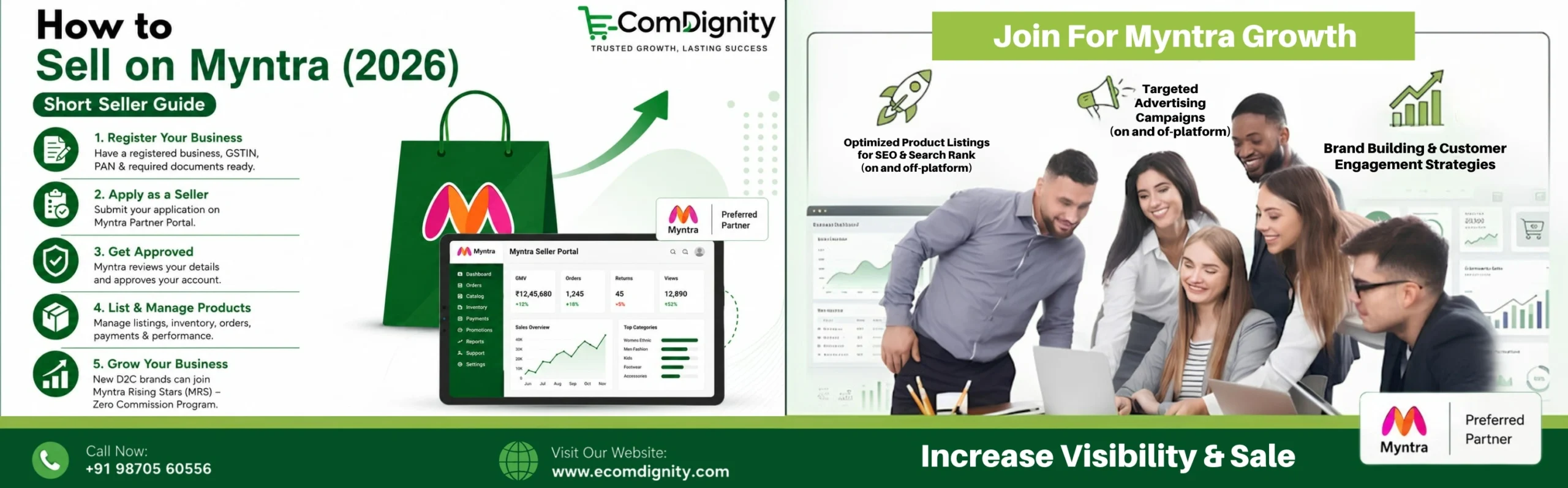
Below is the simple 7-step process to sell on Myntra.
Step 1: Submit Your Seller Interest Form
Head to Myntra’s partner portal and fill out the initial registration form. Verify your mobile number via OTP, then add your organization’s email. Make sure it hasn’t been used on Myntra before.
Step 2: GSTIN Check
Enter your GSTIN and click verify. Once confirmed, this unlocks the rest of the registration sections, which you can fill in any order.
Step 3: Basic Information
Add your contact details like organization email, primary contact name and number, and the owner’s details. You’ll also upload a signature on a plain white background.
Step 4: Business Details
Select your business/fulfilment model. If you’re using a third-party order management system, you’ll choose your service provider and OMS version here.
Step 5: Warehouse Details
Add your pick-up address (multiple allowed), the pin code matching your GST-registered state, warehouse contact details, and your daily order-processing capacity.
Step 6: Bank Details
Enter your account holder name, account number, IFSC code, and bank name, and upload a cancelled cheque from a current account for verification.
Step 7: Brand Details
Enter your brand name(s), complete Myntra’s catalog guidelines sheet, upload your brand logo, and attach your trademark certificate or NOC.
Once submitted, expect a few weeks of review rather than a few days.
How to Sell Clothes on Myntra
Apparel is Myntra’s biggest and most competitive category, so the bar for catalog quality is higher here than almost anywhere else on the platform. If you’re specifically planning to sell clothes on Myntra:
- Sizing charts must be accurate and consistent across every listing. Size-related returns are one of the top reasons apparel sellers lose seller-rating points.
- Product photography needs to meet Myntra’s imagery standards. They must have clean backgrounds, correct model shots, and consistent lighting.
- Fabric and care details should be complete, since Myntra surfaces this on the product page and customers rely on it.
- Trend-relevant categories get discovered faster, as Myntra’s search and recommendation engine favors listings that map cleanly to current fashion search trends.
The Myntra Seller Portal (Login and Daily Operations)
Once registered, all daily operations run through the Myntra seller portal login. This is where you’ll manage:
- Order confirmations and dispatch
- Inventory and stock updates
- Pricing and discount management
- Returns and claims
- Payment reconciliation and settlement reports
If you get locked out, Myntra’s seller support can help you reset access. Keep your registered email and GSTIN handy for verification.
Reconciliation and Payments
The seller portal gives you access to order detail reports, sales revenue reports, and settlement statements, so you can reconcile payments against individual orders. Myntra maps transactions using an order ID release rather than a generic order code, so use that reference specifically when checking your settlements.
Handling Myntra's Seasonal Sales (EORS)
Twice a year, typically late May/early June and again in December, Myntra runs its End of Reason Sale (EORS), its largest fashion clearance event, with discounts reported up to 90% across thousands of brands. For sellers, this is a major visibility opportunity, but it also means a sharp spike in order volume.
To prepare for EORS, you must:
- Freeze and update stock levels well ahead of the sale to avoid listing suppression.
- Automate inventory sync so stock counts update in real time as orders come in. Manual tracking doesn’t hold up under EORS-level order rush.
- Keep buffer inventory on your best-selling SKUs to reduce the risk of overselling during peak traffic.
- Plan ad visibility campaigns in advance, rather than reacting once the sale starts.
Myntra Tagloop: Return Protection for Select Categories
For select high-value categories, apparel, footwear, and other premium goods, Myntra uses Tagloop, a tamper-evident security tag with a unique scannable code. It’s attached during packing and must remain intact for the product to be eligible for return, which helps reduce fraudulent returns and product swaps. If you sell in a Tagloop-eligible category, make sure your packing process captures the Tagloop ID correctly to stay compliant.
Growth Strategies to Increase Sales on Myntra
Myntra seller registration is just the starting point. Growing on Myntra takes ongoing performance — the day-to-day of e-commerce account management that keeps your listings, stock, and metrics healthy. You must follow the following practices to maintain your visibility:
- Maintain product quality and packaging standards consistently across your catalog.
- Stay aligned with Myntra’s fashion-and-lifestyle positioning. Offerings that don’t fit the platform’s niche struggle to get discovered even after approval.
- Track your seller performance metrics, like on-time delivery, order defect rate, and return rate, which directly affect your visibility and standing.
- Avoid stockouts and overselling using real-time inventory tracking and buffer stock.
- Invest in strong product photography and video content to stand out in a visually driven marketplace.
Common Reasons Myntra Registrations Get Rejected
If your Myntra seller registration request gets rejected, then the following may be the reasons for it:
- Mismatched documents. Name or number differences between PAN, GST, and bank details
- Unregistered or unclear brand ownership
- Non-compliant product images that don’t meet Myntra’s photography standards
- Category already saturated or not currently open for new sellers
- Incomplete bank verification for payment settlement
Most of these are avoidable with a clean, complete first submission.
Let's Sum Up!
Selling on Myntra isn’t complicated once you know what the platform is actually looking for. All you need is a genuine brand, valid GST registration, clean documentation, and a catalogue that meets its quality bar. What happens after approval matters just as much: choosing the right fulfilment model, staying inventory-ready for EORS, and keeping your performance metrics healthy.
If you’d rather not manage it yourself, compare the top Myntra account management companies in India before you decide. If you want a professional to handle Myntra seller registration for you, then reach out to Ecom Dignity. We bring years of experience in helping sellers complete their registration process with ease. Contact us right away to book your free strategy call!
Frequently Asked Questions
Find answers to the most common questions about Myntra account management.
Register through Myntra's partner portal with a valid GSTIN, PAN, and business registration; complete the seven-step registration form; and submit your brand and catalogue details for approval. Once verified, you manage everything through the seller portal.
You can't. GST registration is mandatory for every Myntra seller, with no exceptions. Register for GST through the government portal first, then begin your Myntra application.
Timelines vary by brand review and document verification, but expect a few weeks rather than a few days, especially on your first registration.
It's difficult. Myntra prioritizes brand-first sellers, so unbranded or private-label sellers usually face stricter scrutiny.
It's the dashboard where approved sellers manage catalog, inventory, pricing, orders, returns, and payment settlements.
Myntra's zero-commission program for new, homegrown D2C fashion, beauty, and lifestyle brands, letting them sell without paying marketplace commission during their early growth phase.
Fashion apparel, footwear, beauty and personal care, and lifestyle accessories perform strongest.

Siddharth Dwivedi is an eCommerce consultant and entrepreneur specialising in marketplace growth, online business strategy, and digital commerce operations. With hands-on experience in Amazon, Flipkart, and Shopify ecosystems, he works closely with brands and sellers to improve visibility, optimise listings, and scale profitable online operations. Through his blogs, Siddharth shares practical insights, strategies, and real-world learnings to help businesses grow sustainably in the evolving e-commerce landscape.